Bali Local Tour Guide Don’t Choose a Trek Just Because It Is Beautiful
There are many beautiful places to trek in Bali.
Mountains with sunrise views. Waterfalls hidden inside forests. Ancient trails. Rice fields. Villages. Lakes. Remote landscapes. Places that are becoming increasingly popular among travelers.
But when we, as Bali Local Tour Guide, recommend a trekking experience, we don’t simply ask:
“Is this place beautiful?”
Almost every place in Bali is beautiful in its own way.
Instead, we ask:
“What kind of experience does this trail actually offer?”
Some trails are technically challenging.
Some are quiet and remote.
Some take you deep into the forest.
Some reveal how local people live.
Some pass through places that local communities consider sacred.
And some are simply the right mountain for someone who wants to challenge themselves.
This is why we don’t believe there is one best trekking experience in Bali.
There is only the trek that is right for you.
After years of exploring routes, walking through forests, mountains, villages, and waterfalls, these are some of the ways we personally see the trekking experiences we offer.
A Quick Overview of Our Trekking Perspectives
| Trekking Experience |
What We Think Makes It Special |
Best Suited For |
| Mount Sanghyang |
A quiet forest, spiritual atmosphere, technical trail, and sunrise views |
Adventurous trekkers looking for more than an easy sunrise walk |
| Mount Lesung |
Deep jungle, enormous old trees, sacred places, and a route that ends differently from where it begins |
Nature lovers who want to experience the forest rather than chase a viewpoint |
| Mount Batukaru |
A demanding mountain combining forest, endurance, technical terrain, and sunrise |
Experienced trekkers seeking a serious physical challenge |
| Munduk Waterfalls |
Waterfalls connected to village life, agriculture, and mountain landscapes |
Travelers who want more than a waterfall photograph |
| Banyumala Waterfall |
A famous waterfall that can become the entrance to a deeper forest adventure |
Explorers interested in hidden waterfalls and lesser-known routes |
| Tamblingan & Twin Lakes |
Forest, lake, traditional canoeing, and sacred places in one accessible experience |
Travelers looking for an easier but meaningful nature and culture experience |
| Mayong Village |
Rural landscapes, traditional farming, and everyday village life |
Visitors who want to see a quieter and more authentic side of Bali |
| Jatiluwih Rice Fields |
A living agricultural landscape shaped by farmers, water, and tradition |
Travelers who want to understand the story behind Bali’s rice terraces |
| Mount Batur, Abang & Agung |
Three different levels of sunrise mountain adventure |
Trekkers choosing a mountain according to their experience and fitness |
Mount Sanghyang Sunrise Trek
The Sunrise Is Not the Main Reason We Recommend It
Mount Sanghyang is often described as a sunrise trek.
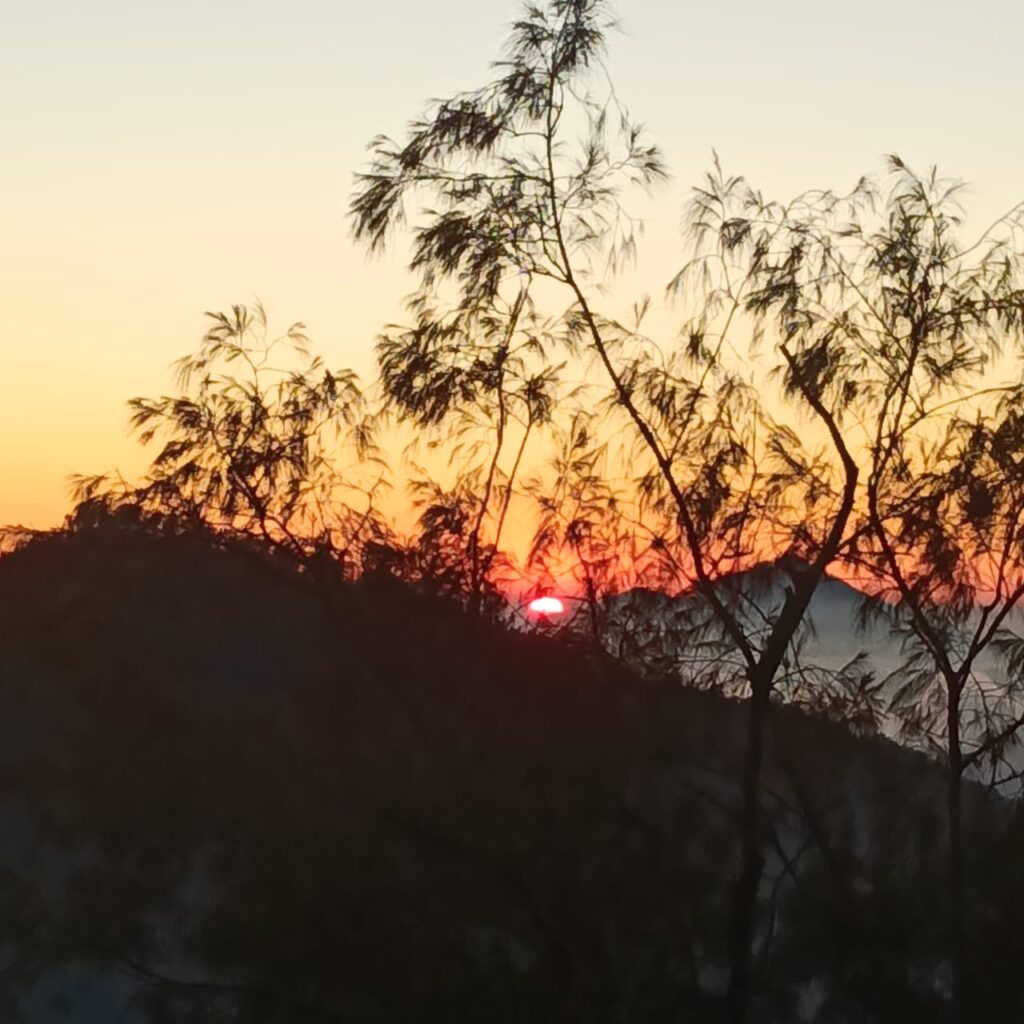
And yes, we believe the sunrise from Mount Sanghyang can be one of the most beautiful sunrise experiences in Bali.
On a clear morning, the sunrise may come with views of Mount Agung, Mount Batur, Mount Abang, Mount Lesung, Mount Catur, Mount Adeng, and other surrounding mountains.
Sometimes the mountains rise above a sea of clouds.
It can be spectacular.
But we always consider those views a bonus.
We cannot guarantee a sea of clouds or perfectly clear mountain views. Weather in the mountains changes, and we believe it is important to be honest about that.
So why do we recommend Mount Sanghyang?
Because the trail itself has a character that is difficult to find on many other sunrise treks in Bali.
The route is quiet.
The forest still feels natural.
And for us, there is a particular atmosphere that begins before the climbing even starts.
Before entering the mountain forest, we traditionally take time to pray at the temple near the entrance. It is our way of asking for safety and permission before entering the mountain.
As you continue through the forest, you may notice small groups of canang — simple Balinese offerings made from flowers and woven palm leaves — placed around trees and other areas of the forest.
They may look very simple.
But for local people, they are reminders that this forest is not simply a place for recreation.
It is respected.
It has a spiritual character.
Then comes the physical side of the experience.
Mount Sanghyang is not a simple uphill walk.
Several sections require good balance, careful foot placement, and proper trekking technique.
For us, this is what makes the route interesting.
So we would describe Mount Sanghyang like this:
Technical trail.
Quiet forest.
Strong atmosphere.
Sunrise as the reward.
If you are looking for an easy sunrise walk, this may not be the first trek we recommend.
If you are looking for a more adventurous sunrise experience with a natural and spiritual mountain atmosphere, this is where Mount Sanghyang becomes interesting.
Don’t Come Here Looking for a Viewpoint
We sometimes have to explain Mount Lesung in a different way.
If your main goal is to stand on a summit and photograph a spectacular panorama, Mount Lesung may not be the mountain we recommend.
But if your question is:
“Where can I experience a real mountain forest?”
Then our answer changes.
Mount Lesung is about the journey through the forest.
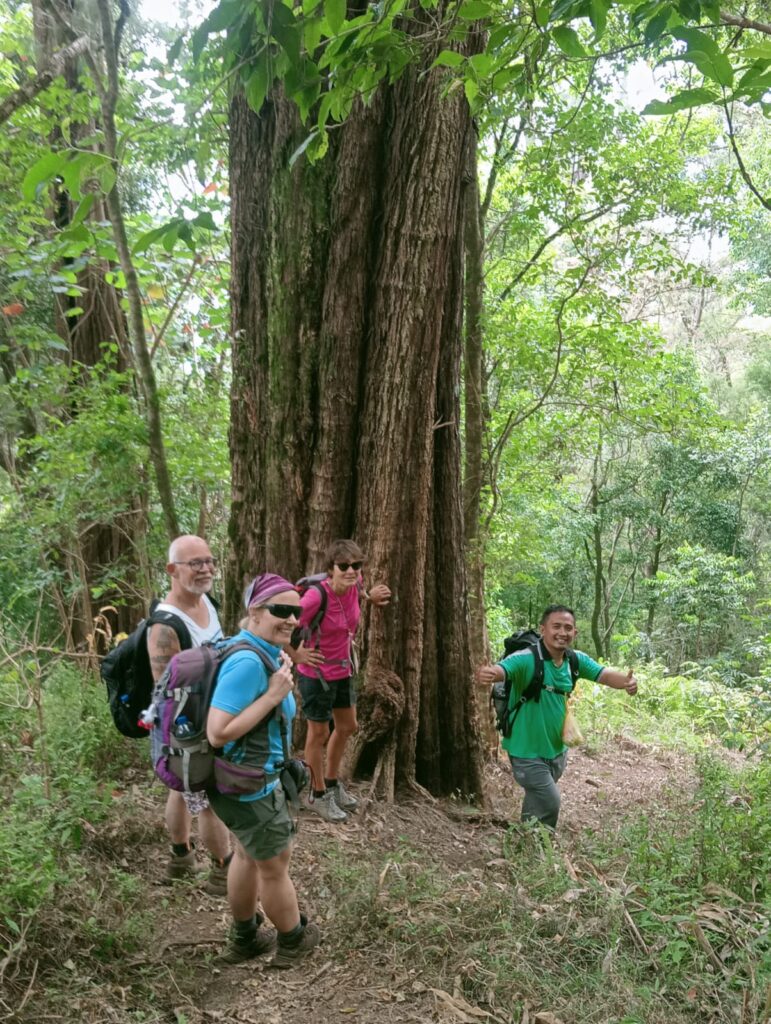
The route from Pucak toward Tamblingan takes you through an environment where you can encounter enormous old trees, some of the most impressive trees we have seen in Bali.
The forest is the attraction.
Not the viewpoint.
And there is another side of Mount Lesung that many visitors may not immediately understand.
Inside the forest are small sacred places.
They do not necessarily look like the large, beautifully decorated temples that people commonly associate with Bali.
Some are very small.
Some may appear almost hidden.
But their importance is not measured by their size.
Places such as the area around Pura Gua Nagaloka, near the ancient cave along the route, are respected by local communities.
For us, walking through Mount Lesung therefore means walking through two landscapes at once:
a natural landscape and a culturally respected landscape.
We also like the fact that the starting point and finishing point are different.
You don’t simply walk the same trail twice.
And when the trek is combined with a traditional dugout canoe crossing on Tamblingan Lake, the experience changes again.
Forest.
Mountain.
Sacred places.
Lake.
Canoe.
A different ending from the beginning.
That is why we recommend Mount Lesung to people who want to feel the forest rather than simply photograph a mountain.
Mount Batukaru Sunrise Trek
A Mountain That Demands More From You
Mount Batukaru is a different level of experience.
In our view, it combines some of the characteristics we appreciate about Mount Lesung and Mount Sanghyang:
forest, atmosphere, technical terrain, and mountain adventure.
But it asks more from the trekker.
The climb requires endurance and determination.
Among local guides, Mount Batukaru has a reputation for being an especially demanding mountain. Some guides even consider the route more physically challenging than Mount Agung in certain respects.
We don’t say this to make the trek sound intimidating.
We say it because the mountain deserves to be taken seriously.
Mount Batukaru is not simply about reaching another summit.
It is about accepting the effort required to get there.
For trekkers who enjoy difficult routes and want a sunrise experience combined with a serious mountain challenge, Mount Batukaru can be a very rewarding choice.

Munduk Waterfall Trek
The Waterfalls Are Only One Part of Munduk
A visitor can look at a Munduk waterfall trek and think:
“I am going to see some waterfalls.”
That is true.
But it is not how we see the experience.
Especially on the longer route exploring several waterfalls, the waterfalls are only part of the story.
The bigger story is Munduk itself.
Munduk is a village landscape shaped by agriculture.
As you walk, you can encounter coffee, cloves, cocoa, vanilla, and other crops that continue to be part of local livelihoods.
You begin to see that the forest and waterfalls are connected to the lives of the people who live here.
Water comes from the landscape.
Agriculture depends on that environment.
People work the land.
The village grows around it.
And eventually tourism develops around the beauty that already existed.
That connection is what interests us.
So when we guide a longer Munduk trek, we don’t want guests to remember only the names of the waterfalls.
We want them to remember:
“I walked through a real working village in the mountains of Bali.”
This is also why we see a similar character in our Sekumpul and Sambangan waterfall trekking experiences.
The waterfall gets you there.
The landscape tells you the story.
Banyumala Waterfall Trek
For Us, Banyumala Is a Starting Point
This is one of the clearest examples of the difference between a visitor’s perspective and a local guide’s perspective.
For many travelers:
Banyumala = beautiful waterfall.
You park your vehicle, walk down for around fifteen minutes, reach the waterfall, swim, take photographs, and walk back.
There is absolutely nothing wrong with that.
But for us, that is only the beginning.
We know the forest beyond Banyumala.
From the waterfall area, there are routes leading deeper into the surrounding landscape.
With the right local knowledge, conditions, and route selection, the wider forest can reveal other waterfalls — several of them — as well as hidden areas and small sacred places.
This is something a visitor walking alone may not see.
To them, the forest may simply look like a forest.
To someone who knows the area, the forest can contain:
another trail,
another stream,
another waterfall,
another hidden place,
another story.
That is why we see Banyumala differently.
The famous waterfall is not the end of the experience.
It can be the entrance to the adventure.
Tamblingan & Twin Lakes Jungle Trek
Easy to Walk, Rich in Experience
We would describe the Tamblingan and Twin Lakes jungle trekking experiences as relatively easy.
You don’t need advanced trekking technique.
You don’t need to be an experienced mountain climber.
But that does not mean there is little to discover.
Within a relatively short experience, you can combine:
forest, lake, traditional canoe, and sacred places.
The dugout canoe crossing on Tamblingan is particularly important to us because it changes the pace completely.
Instead of simply walking from one tourist attraction to another, you slow down.
You are on the water.
Surrounded by forest and mountains.
And the journey itself becomes part of the experience.
For nature lovers and travelers interested in local culture, we see Tamblingan as one of those experiences where difficulty is not the measure of value.
Sometimes an easy trek can still be a very complete experience.
Mayong Village Trek
Don’t Just Walk Through Bali — See How People Live
Mayong is not about finding a dramatic summit.
It is not about chasing a waterfall.
It is about seeing rural Bali.
For us, a village walking experience becomes meaningful when visitors can observe the landscape as local people experience it every day.
Traditional farming.
Village paths.
Agricultural land.
Local houses.
Farmers working.
The rhythm of a rural community.
These things are easy to overlook when traveling between Bali’s famous attractions.
But they tell us something important about the island.
Bali is not only the Bali that appears in travel photographs.
There is another Bali that is quieter.
More ordinary.
More agricultural.
And in some places, still strongly connected to traditional ways of living.
That is the Bali we want people to experience in Mayong.
Jatiluwih Rice Field Walking
The Landscape Is Beautiful Because Someone Works It
Jatiluwih is famous because it is beautiful.
But we think there is another question worth asking:
Why does this landscape look the way it does?
The rice terraces are working agricultural land.
Behind the scenery are farmers, water, cultivation, knowledge, cooperation, and generations of people working with the landscape.
When you walk through the rice fields rather than simply looking at them from a viewpoint, the landscape starts to make more sense.
You see the work behind the beauty.
For us, that is the real value of a Jatiluwih walking experience.
The rice terrace is not a decoration. It is someone’s living landscape.
Mount Batur, Mount Abang & Mount Agung
Choosing a Mountain That Matches Your Experience
For travelers whose main goal is a sunrise mountain adventure, we see these three mountains differently.
Not because one is “better” than the others.
Because they offer different levels of challenge.
Mount Batur
For someone beginning their mountain trekking journey, Mount Batur is often the most approachable choice.
It is a good introduction to Bali sunrise trekking.
Mount Abang
For those who want to move beyond the beginner level, Mount Abang offers a more demanding experience and a different mountain environment.
Mount Agung
For experienced trekkers, Mount Agung is a much more serious undertaking.
As Bali’s highest mountain, it requires preparation, physical readiness, and respect for the conditions.
Our simple way of explaining them is:
Batur — Beginner
Abang — Intermediate
Agung — Advanced
Of course, fitness, weather, route conditions, and individual experience always matter. This is our general way of helping guests understand the character of each mountain, not a substitute for proper preparation.
So, Which Trek Is Right for You?
This is probably the most important part of our trekking perspective.
We don’t believe in asking:
“What is the best trek in Bali?”
We believe the better question is:
“What kind of experience are you looking for?”
If you want a technical sunrise adventure with a quiet and spiritual forest atmosphere:
Mount Sanghyang.
If you want deep forest, enormous trees, sacred places, and a different start and finish:
Mount Lesung.
If you want a serious physical challenge:
Mount Batukaru.
If you want waterfalls combined with village and agricultural landscapes:
Munduk, Sekumpul, or Sambangan.
If you want to go beyond a famous waterfall and explore deeper into the forest:
Banyumala.
If you want an easier experience combining forest, lake, canoe, and culture:
Tamblingan and the Twin Lakes.
If you want to see rural life and traditional farming:
Mayong.
If you want to understand the agricultural landscape behind one of Bali’s most famous rice terraces:
Jatiluwih.
And if what you really want is a sunrise mountain challenge:
Batur, Abang, or Agung, depending on your experience.
Our Role as Local Guides
This is why we believe the role of a local guide is more than simply knowing the way.
A map can show you where a trail goes.
A photograph can show you what the destination looks like.
A search engine can tell you how many meters high a mountain is.
But local experience can help explain what kind of place you are actually entering.
We know that a quiet forest feels different from a busy tourist trail.
We know that some mountains are about endurance rather than scenery.
We know that some waterfalls are only the visible part of a much larger landscape.
We know that a small temple in the forest may have much more meaning to local people than its appearance suggests.
And we know that sometimes the most memorable part of a trek happens between the starting point and the destination.
That is why, when we recommend a trekking experience, we are not simply selling a route.
We are sharing our understanding of that route.
A Trek Is More Than a Destination
After exploring many parts of Bali, this is perhaps the simplest way we can explain our perspective:
Don’t judge a trek only by what you see at the end.
A mountain is more than its summit.
A waterfall is more than the water.
A forest is more than trees.
A village is more than a place you walk through.
A rice terrace is more than a photograph.
And a sunrise is more than the moment the sun appears.
The real experience is often found in everything that happens along the way.
That is what we look for when we explore.
That is what we consider when we create our trekking experiences.
And that is what we hope our guests discover when they walk with us.
Not simply another destination in Bali.
But a trail with its own character.