Mount Sanghyang is one of Bali’s lesser-known mountain landscapes, located in the highlands of Tabanan near the forested area of Tamblingan – North Bali. At around 2,087 metres above sea level, it is considerably quieter than Bali’s better-known mountains such as Mount Batur and Mount Agung.
For hikers, Mount Sanghyang is attractive because of its forest, mountain atmosphere, and panoramic surroundings. But there is another side of the mountain that is equally important: its relationship with Bali’s spiritual landscape.
The meaning of Mount Sanghyang cannot be understood simply by looking at it as a hiking destination. In Bali, mountains are often more than geographical landmarks. They can be connected with temples, water sources, forests, agriculture, ancestral traditions, and religious practices.
For this reason, exploring Mount Sanghyang is not only about reaching the summit. It can also be an opportunity to understand how nature and spirituality are connected in the Balinese landscape.
What Is Mount Sanghyang?
Mount Sanghyang, locally also known by variations of its name such as Gunung Sengjang or Sengayang, is located in the highland region of Tabanan, near the Tamblingan area. Sources commonly place its elevation at around 2,087 metres above sea level.
The mountain is surrounded by forested highland landscapes and is associated geographically with the broader mountain environment around Tamblingan and Bedugul.
Unlike Mount Batur, which has become one of Bali’s most established tourist trekking destinations, Mount Sanghyang receives far fewer visitors.
That difference is part of its character.
The experience here is more strongly connected with forest, quiet trails, mountain vegetation, and the surrounding rural landscape.
For travelers who enjoy walking through natural environments rather than visiting highly developed tourist attractions, this can be an important part of the appeal.
Why Are Mountains Important in Balinese Culture?
To understand the spiritual character of Mount Sanghyang, it helps to understand the broader role of mountains in Balinese culture.
Mountains have traditionally been associated with the sacred and higher realms of the Balinese Hindu worldview. This is one reason why many important temples and sacred sites are connected with mountain landscapes.
Mountains are also closely connected with water.
Rain falls on the highlands, forests retain moisture, springs emerge from the landscape, and rivers carry water toward agricultural areas and villages.
The relationship between mountains, water, agriculture, and religious life is therefore not simply symbolic.
It is also part of the physical environment in which Balinese communities have developed.
The importance of Mount Batukaru, for example, is documented through its associated temples and religious traditions. The Bali Cultural Heritage Preservation Office describes Pura Luhur Batukaru as an important sacred center connected with the surrounding mountain landscape and agricultural communities.
Mount Sanghyang exists within this wider highland environment.
The Spiritual Meaning of Mount Sanghyang
The name Sanghyang itself has a spiritual character in Balinese language and culture, but it is important not to reduce the mountain’s meaning to the name alone.
Local traditions and accounts describe the mountain as having a spiritual atmosphere, with a small sacred place along the trekking area where Hindu visitors may pray and ask for protection before continuing their journey.
For local people, a place like this is not necessarily something that needs to be explained through dramatic legends.
Its importance can be much simpler.
A mountain can be respected because it is part of the natural and spiritual environment of the community.
A forest can be protected because it is associated with sacred places.
A spring can be valued because it provides water for people, agriculture, and religious activities.
This is one of the ideas that makes Bali’s mountain landscapes so interesting.
Nature and spirituality are often not treated as completely separate subjects.
The Stories and Legends Associated With Mount Sanghyang
Mount Sanghyang is surrounded by local stories and oral traditions, but not every story associated with the mountain should automatically be presented as documented historical fact.
This distinction is important.
Bali has a rich tradition of passing stories from one generation to another. Some stories explain the origins of places, temples, mountains, forests, or villages. Others are connected with religious beliefs or local customs.
These stories are valuable because they help explain how people understand their environment.
However, when sharing them with visitors, it is better to describe them as local stories, traditions, or beliefs rather than presenting every element as proven history.
A local guide can be particularly helpful here because the meaning of a story may depend on the community and the context in which it is told.
Instead of simply asking whether a legend is “true,” it can be more interesting to ask:
What does this story tell us about the way local people understand the mountain?
Mount Sanghyang and Bali’s Sacred Mountain Landscape
Mount Sanghyang should also be understood as part of a much larger mountain landscape.
The highlands around Tabanan and northern Bali contain a network of mountains, forests, lakes, rivers, agricultural areas, and sacred sites.
Mount Batukaru is one of the most important examples.
The Bali provincial government describes Pura Batukaru as a sacred site associated with Dewa Mahadewa and the western direction within the Dewata Nawa Sanga concept.
Mount Sanghyang is not simply an isolated mountain standing in the middle of this landscape.
It belongs to a highland environment where mountains, forests, lakes, and water systems are closely connected.
This broader perspective makes a visit more meaningful.
Instead of thinking:
“I am climbing one mountain.”
you can think:
“I am entering one part of Bali’s larger mountain and forest landscape.”
Forest, Water, and Spirituality
One of the most interesting things about Mount Sanghyang is the relationship between its forest environment and the surrounding water landscape.
The mountain and highland forests receive substantial rainfall. Vegetation helps retain moisture, while streams and springs carry water down toward lower areas.
The nearby Tamblingan landscape demonstrates how closely water, forest, and local culture can be connected.
This is also why protecting mountain forests is important beyond the hiking experience itself.
The forest is not simply scenery.
It is part of a wider ecological system that supports water, agriculture, wildlife, and communities.
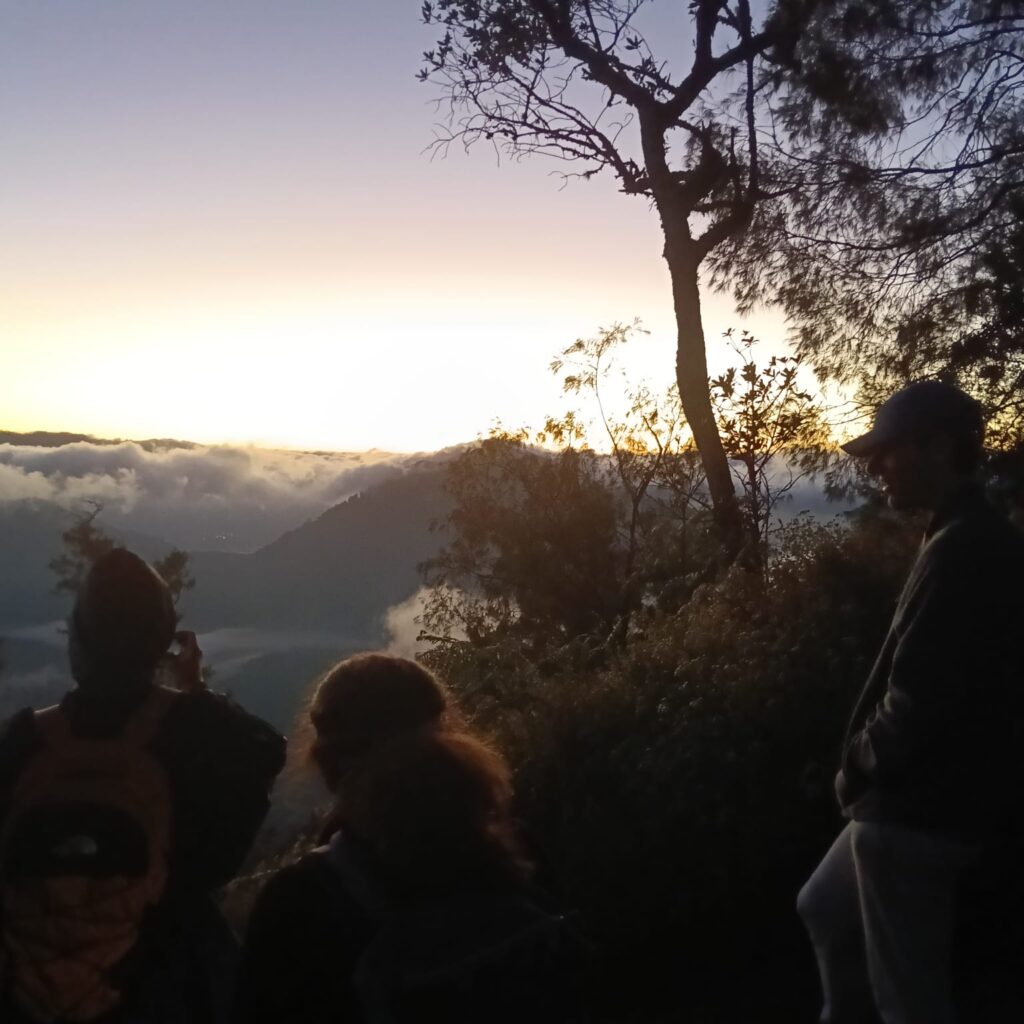
For visitors, this becomes particularly noticeable during a trek.
You may walk through dense vegetation, cross wet sections of trail, hear running water, and see how quickly the environment changes with elevation and weather.
What Makes Mount Sanghyang Different From Other Mountains in Bali?
Mount Sanghyang is different from Bali’s most famous mountains mainly because of its atmosphere and level of development.
Mount Batur is well known for sunrise trekking and attracts large numbers of visitors.
Mount Agung is Bali’s highest mountain and has a major religious significance associated with the wider Besakih landscape. Indonesia’s official tourism information describes Mount Agung as Bali’s sacred mountain and an active stratovolcano.
Mount Sanghyang offers something different.
Its appeal is more closely connected with:
- forest
- solitude
- highland scenery
- local traditions
- quiet trekking
- the surrounding Tamblingan landscape
It does not need to compete with Mount Batur or Mount Agung.
It offers another type of mountain experience.
The Quiet Atmosphere of Mount Sanghyang
One of the first things many hikers notice on a less-developed mountain trail is the absence of the usual tourist atmosphere.
There may be fewer facilities, fewer commercial stops, and fewer crowds.
Instead, the experience is shaped by:
- birdsong
- wind moving through the forest
- wet leaves
- moss-covered trees
- mountain mist
- changing light
- distant views through the vegetation
This quietness can change the way you experience the trek.
You are not constantly moving from one attraction to another.
You have more time to notice the environment.
For some travelers, this is where the spiritual side of the mountain becomes easier to appreciate—not because something supernatural necessarily happens, but because the forest encourages a slower and more reflective experience.
Mount Sanghyang as a Place for Reflection
A mountain environment can naturally create space for reflection.
The physical effort of walking, the absence of traffic, and the surrounding forest can make the experience very different from a normal sightseeing trip.
You may spend several hours walking without seeing the buildings and traffic that dominate Bali’s more developed areas.
This can make Mount Sanghyang appealing to travelers who are interested in:
- nature
- hiking
- photography
- quiet environments
- mindfulness
- cultural understanding
- spiritual landscapes
However, visitors should avoid assuming that every mountain experience in Bali is a form of meditation or spiritual retreat.
The meaning is personal.
For local communities, the mountain may have cultural and religious significance.
For a visitor, it may simply provide an opportunity to slow down and experience the landscape with greater attention.
Both perspectives can coexist respectfully.
Respecting the Spiritual Landscape
If you visit Mount Sanghyang, remember that you are entering more than a natural environment.
There may be places that have cultural or religious significance to local people.
Visitors should therefore behave respectfully.
Do not enter restricted areas
If a local guide or community member tells you that an area should not be entered, respect the instruction.
Do not disturb offerings
If you encounter religious offerings, shrines, or ceremonial objects, leave them undisturbed.
Dress appropriately
When visiting sacred places, modest clothing is appropriate.
Avoid unnecessary noise
A quiet environment is part of the character of the mountain.
Do not treat sacred places as photo props
Photography should never come before cultural respect.
Follow local guidance
Rules can vary between locations, so local advice is important.
Responsible behavior is especially important on mountains that are not developed as mass-tourism destinations.
Can You Trek Mount Sanghyang?
Yes, Mount Sanghyang is known as a trekking destination, but it should not be approached like a highly commercialized tourist attraction.
Published local travel information describes trekking through the forest toward the mountain’s summit area, with routes associated with the Tamblingan/Bedugul side and other local approaches.
Trail conditions can change because of weather, vegetation, rainfall, and local access.
For this reason, information about route duration or difficulty should be treated as an estimate rather than a guarantee.
Your actual trekking time can depend on:
- fitness
- weather
- trail conditions
- route chosen
- group size
- walking pace
- stops along the way
If you are unfamiliar with the area, arranging a local guide is strongly recommended.
Local Stories Are Part of the Experience
One of the reasons we believe local guiding matters is that many aspects of Bali cannot be fully understood from a signboard.
A story about a mountain may have been passed down through a family or community.
A particular tree may have a local name that does not appear in a guidebook.
A small shrine may have meaning that is invisible to someone passing by.
A guide who grew up around the region can help explain these details.
At the same time, we believe these stories should be presented honestly.
When something is a local belief, we describe it as a local belief.
When something is documented history, we distinguish it as history.
This allows visitors to appreciate Balinese traditions without turning them into exaggerated mystery stories.
Mount Sanghyang and the Tamblingan Landscape
One of the most interesting ways to experience Mount Sanghyang is to understand it together with the surrounding Tamblingan highlands.
The area contains a combination of:
mountains + forest + lake + water + village + agriculture
This combination creates a landscape where natural and cultural elements are closely connected.
The nearby Lake Tamblingan area is particularly known for its forested setting and traditional cultural landscape.
For travelers interested in more than mountain climbing, this opens the possibility of creating a broader experience around the highlands rather than treating Mount Sanghyang as an isolated destination.
A Different Way to Experience Bali’s Mountains
Mount Sanghyang Trek does not need dramatic claims to be interesting.
Its value comes from the combination of landscape and culture.
You have the mountain itself, the surrounding forest, the nearby highland lakes, local communities, agricultural landscapes, and the spiritual traditions that have developed around Bali’s mountains.
For visitors, the most meaningful experience may simply be walking through the forest with enough time to notice what is around them.
A mountain does not have to be famous to be important.
And a sacred landscape does not have to be surrounded by mystery to deserve respect.
Discover Mount Sanghyang Through the Eyes of a Local Guide
Mount Sanghyang offers a quieter side of Bali’s mountain landscape.
It is a place where forest, mountain, water, culture, and spirituality come together.
You do not need to believe every legend or search for something mysterious to appreciate the mountain.
Sometimes the most meaningful experience is simply understanding why a landscape matters to the people who live around it.
Walk slowly.
Listen to the forest.
Respect the sacred places.
Ask questions.
And allow the mountain to be more than just another destination on your Bali itinerary.
If you would like to explore Mount Sanghyang with a local guide, Bali Local Tour Guide Community can arrange private and customized trekking experiences, including English-, German-, and French-speaking guides subject to availability.